


🎉 Limited-Time Offer: Save 50% on Enrollment! Use coupon code DMF50 at checkout to receive 50% off the course fee. Offer ends October 22, 2026.
Build the essential skills to understand, plan, and apply effective digital marketing strategies.
Digital marketing has become an essential skill for businesses, entrepreneurs, and professionals in today’s digital-first world. This beginner-friendly course provides a comprehensive introduction to the concepts, tools, and strategies used to build online visibility, attract audiences, generate leads, and measure marketing performance.
Throughout this course, you will explore the complete digital marketing ecosystem, including digital marketing strategy, branding, customer personas, content marketing, artificial intelligence (AI) in marketing, search engine optimization (SEO), social media marketing, email marketing, online advertising, analytics, and conversion optimization.
Through carefully selected educational videos, real-world examples, learning resources, and knowledge assessments, you will discover how different digital marketing channels work together to support business goals. By the end of the course, you will have a strong foundation in digital marketing principles and the ability to understand and apply fundamental strategies in real-world marketing situations.
What You Will Learn
By completing this course, you will be able to:
Who This Course Is For
This course is designed for:
Course Approach
This course combines curated educational videos, real-world examples, learning resources, and automated assessments to help students build a strong understanding of digital marketing fundamentals.
Certificate of Completion
Upon successful completion of the course and all required assessments, you will receive a Certificate of Completion issued by the American Institute of Extended Studies (AIES).
This certificate recognizes your achievement in Digital Marketing Fundamentals and can be added to your résumé, professional portfolio, or LinkedIn profile to showcase your commitment to professional development.
Certificate Preview
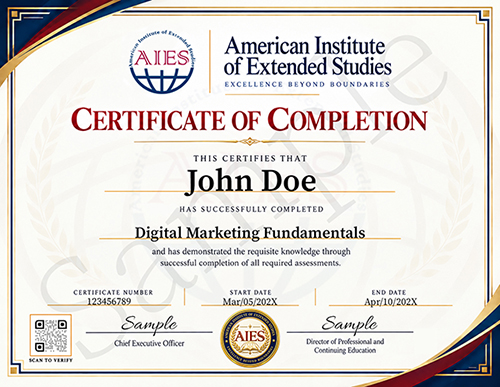
Sample certificate for illustration purposes. The final certificate will be issued with the learner’s name and course details upon successful completion.

Explore the fundamentals of digital marketing, including how it differs from traditional marketing, why it matters, and the key digital channels businesses use to reach and engage customers online.

Review and reinforce the essential concepts covered in Lesson 1. This study guide includes key definitions, digital marketing channels, customer journey models, marketing strategy frameworks, practical examples, and review questions to strengthen your understanding and prepare for assessments.

Explore how websites, search, content, social media, email, advertising, data, and marketing technology work together as one connected digital marketing ecosystem.
Review and reinforce the essential concepts covered in Lesson 2. This study guide explores the digital marketing ecosystem, including owned, paid, and earned media, marketing channels, customer journeys, marketing technology, data analytics, and integrated marketing strategies. It includes key definitions, practical examples, strategic planning frameworks, and review questions to strengthen your understanding and prepare for assessments.
Learn how customers move from awareness to consideration, conversion, and retention, how digital touchpoints influence decisions, and how marketers use customer journey mapping to identify opportunities and reduce friction.
Review and reinforce the essential concepts covered in Lesson 3. This study guide explores the five stages of the customer journey—awareness, consideration, conversion, retention, and advocacy. It covers customer touchpoints, journey mapping, customer experience, identifying friction, and measuring marketing performance. It includes key definitions, practical examples, a real-world case study, and review questions to strengthen your understanding and prepare for assessments.
Learn how to turn business goals into a practical digital marketing strategy by defining objectives, identifying audiences, developing messages, selecting channels, choosing metrics, and using results to improve future marketing decisions.
Review and reinforce the essential concepts covered in Lesson 4. This study guide explores digital marketing strategy development, including SMART objectives, target audiences, value messaging, channel selection, customer actions, and key performance indicators (KPIs). It includes strategic planning frameworks, practical examples, key definitions, and review questions to strengthen your understanding and prepare for assessments.
Explore the fundamentals of branding, including brand identity, positioning, differentiation, values, personality, voice, consistency, and how organizations create recognizable and meaningful experiences across digital touchpoints.
Review and reinforce the essential concepts covered in Lesson 5. This study guide explores branding fundamentals, including brand identity, positioning, differentiation, brand values, personality, voice, tone, and messaging. It covers brand consistency across digital channels, brand guidelines, and measuring brand equity. It includes key definitions, practical examples, a brand-building framework, and review questions to strengthen your understanding and prepare for assessments.
Learn how marketers identify, research, segment, and understand target audiences using demographics, behaviors, needs, motivations, and buyer personas to create more relevant marketing experiences.
Review and reinforce the essential concepts covered in Lesson 6. This study guide explores target audience identification, market segmentation, customer needs, motivations, pain points, and buyer personas. It covers audience research methods, first-party data, personalization, and using customer insights to make effective marketing decisions. It includes key definitions, practical frameworks, real-world examples, and review questions to strengthen your understanding and prepare for assessments.
Learn how websites support digital marketing, what makes an effective landing page, how calls to action and user experience influence customer behavior, and how marketers measure and improve website conversions.
Review and reinforce the essential concepts covered in Lesson 7. This study guide explores the role of websites in digital marketing, landing pages, calls to action (CTAs), user experience, usability, and conversion measurement. It covers mobile accessibility, building customer trust, conversion rate optimization (CRO), and A/B testing. It includes key definitions, practical examples, a landing-page audit framework, and review questions to strengthen your understanding and prepare for assessments.
Explore ethical and responsible digital marketing practices, including honesty, transparency, privacy, responsible data use, advertising disclosures, reviews and endorsements, deceptive design, accessibility, inclusive marketing, and customer trust.
Review and reinforce the essential concepts covered in Lesson 8. This study guide explores ethical digital marketing practices, including honesty, transparency, customer privacy, consent, responsible targeting, and data protection. It covers influencer disclosures, authentic reviews, dark patterns, accessibility, inclusion, and building long-term customer trust. It includes key definitions, practical examples, an ethical decision-making framework, and review questions to strengthen your understanding and prepare for assessments.
Learn the fundamentals of content marketing, including how organizations create useful and relevant content, connect content to audience needs and customer journey stages, distribute it across digital channels, and measure its contribution to marketing goals.
Review and reinforce the essential concepts covered in Lesson 9. This study guide explores content marketing fundamentals, including audience-focused content creation, content formats, customer journey stages, SEO, distribution, and calls to action. It covers content repurposing, performance measurement, content maintenance, and AI-assisted content creation. It includes key definitions, practical examples, a content planning framework, and review questions to strengthen your understanding and prepare for assessments.
Learn how to turn content marketing goals into an organized content strategy by defining objectives, audiences, content themes, formats, workflows, distribution plans, editorial calendars, responsibilities, and performance measures.
Review and reinforce the essential concepts covered in Lesson 10. This study guide explores content strategy development, including marketing objectives, audience needs, content pillars, customer journey mapping, and editorial calendars. It covers content planning workflows, team responsibilities, content governance, distribution, repurposing, content audits, and performance measurement. It includes key definitions, practical planning frameworks, real-world examples, and review questions to strengthen your understanding and prepare for assessments.
Explore how artificial intelligence tools can support digital marketing tasks such as research, content development, personalization, campaign management, advertising, analytics, and workflow automation, while learning how to prompt, evaluate, verify, and select AI tools effectively.
Review and reinforce the essential concepts covered in Lesson 11. This study guide explores artificial intelligence in digital marketing, including generative AI, predictive analytics, personalization, automation, AI agents, and effective prompting techniques. It covers AI-assisted content creation, campaign optimization, human oversight, data protection, tool evaluation, and performance measurement. It includes key definitions, practical examples, an AI-assisted marketing workflow framework, and review questions to strengthen your understanding and prepare for assessments.
Learn how to use artificial intelligence responsibly in digital marketing by addressing accuracy, privacy, bias, transparency, human oversight, intellectual property, synthetic media, accountability, and AI governance while protecting customers and brand trust.
Review and reinforce the essential concepts covered in Lesson 12. This study guide explores responsible AI use in digital marketing, including accuracy, fact-checking, customer privacy, data protection, bias, fairness, transparency, and human oversight. It covers synthetic media, intellectual property, responsible personalization, AI governance, and risk management. It includes key definitions, practical examples, a responsible-AI decision-making framework, and review materials to strengthen your understanding and prepare for assessments.
Learn how search engine optimization helps people discover useful website content through organic search. Explore how search engines crawl, index, and serve content, how search intent influences results, and how content, technical accessibility, authority, and measurement work together in SEO.
Review and reinforce the essential concepts covered in Lesson 13. This study guide introduces search engine optimization (SEO), including organic search, how search engines work, keyword research, and search intent. It covers content SEO, on-page optimization, technical SEO, off-page authority, local SEO, and search performance measurement. It includes key definitions, practical examples, an online education case study, and review questions to strengthen your understanding and prepare for assessments.
Build practical SEO skills by learning how to research keywords, interpret search intent, optimize page titles, headings, descriptions, links, images, and content structure, address basic technical SEO issues, and measure organic search performance.
Review and reinforce the essential concepts covered in Lesson 14. This study guide explores practical search engine optimization (SEO), including keyword research, search intent, on-page optimization, meta descriptions, internal linking, and image optimization. It covers technical SEO, crawling and indexing, mobile performance, backlink building, and measuring results with Google Search Console. It includes key definitions, practical examples, an SEO optimization workflow, a case study, and review questions to strengthen your understanding and prepare for assessments.
Learn how to build a purposeful social media marketing strategy by connecting business goals with audience needs, selecting appropriate platforms, developing content themes, encouraging engagement, managing communities, balancing organic and paid activity, and measuring meaningful results.
Review and reinforce the essential concepts covered in Lesson 15. This study guide explores social media marketing strategy development, including audience targeting, platform selection, content pillars, brand voice, and community engagement. It covers organic, paid, and earned social media, social listening, customer care, influencer partnerships, content planning, and performance measurement. It includes key definitions, practical examples, a social media strategy framework, a case study, and review questions to strengthen your understanding and prepare for assessments.
Learn how to turn social media strategy into a coordinated campaign by defining objectives, audiences, messages, creative concepts, calls to action, content schedules, roles, tracking, testing, and performance measures from campaign brief through post-campaign analysis.
Review and reinforce the essential concepts covered in Lesson 16. This study guide explores social media campaign development, including SMART objectives, campaign briefs, audience targeting, creative messaging, platform selection, and calls to action (CTAs). It covers campaign timelines, budgets, organic and paid distribution, UTM tracking, key performance indicators (KPIs), A/B testing, and campaign optimization. It includes key definitions, practical examples, a campaign planning framework, a case study, and review questions to strengthen your understanding and prepare for assessments.
Explore how email marketing helps businesses build customer relationships through relevant, permission-based communication. Learn about subscriber lists, email types, segmentation, personalization, automation, deliverability, responsible data practices, and the key metrics used to evaluate email marketing performance.
Review and reinforce the essential concepts covered in Lesson 17. This study guide explores email marketing fundamentals, including permission-based list building, subscriber segmentation, personalization, email campaigns, and marketing automation. It covers effective email design, calls to action, deliverability, sender authentication, privacy, compliance, and performance measurement. It includes key definitions, practical examples, an email marketing planning framework, a case study, and review questions to strengthen your understanding and prepare for assessments.
Learn how to plan, create, test, and launch effective email marketing campaigns. Explore audience segmentation, subject lines, email content, calls to action, campaign scheduling, tracking, and performance measurement to improve engagement and conversions.
Review and reinforce the essential concepts covered in Lesson 18. This study guide explores email campaign planning and execution, including SMART objectives, campaign briefs, audience segmentation, subscriber eligibility, subject lines, preview text, and calls to action (CTAs). It covers responsive email design, accessibility, landing-page alignment, campaign tracking, scheduling, deliverability, A/B testing, and performance measurement. It includes key definitions, practical examples, a campaign planning framework, an AIES case study, and review questions to strengthen your understanding and prepare for assessments.
Learn how paid digital advertising helps organizations reach relevant audiences across search engines, websites, and social media. Explore advertising objectives, formats, targeting, budgets, ad auctions, key performance metrics, campaign measurement, and responsible advertising practices.
Review and reinforce the essential concepts covered in Lesson 19. This study guide explores digital advertising fundamentals, including paid, owned, and earned media, advertising objectives, search ads, display advertising, paid social media, video ads, and audience targeting. It covers campaign structure, ad creative, budgeting, bidding strategies, conversion tracking, and performance metrics such as CTR, CPC, CPM, CPL, and ROAS. It includes key definitions, practical examples, a digital advertising planning framework, a case study, and review questions to strengthen your understanding and prepare for assessments.
Learn how to develop and improve digital advertising campaigns by setting measurable objectives, choosing audiences and channels, allocating budgets, creating relevant advertisements, testing campaign elements, and analyzing performance. Apply practical optimization techniques to improve advertising efficiency, conversions, and return on investment while maintaining responsible marketing practices.
Review and reinforce the essential concepts covered in Lesson 20. This study guide explores digital advertising strategy and optimization, including SMART objectives, campaign planning, audience targeting, channel selection, budget allocation, and bidding strategies. It covers ad creative, landing-page optimization, A/B testing, conversion tracking, performance analysis, and key metrics such as CTR, CPC, CPL, and ROAS. It includes key definitions, practical examples, a campaign optimization framework, a comparative advertising case study, and review questions to strengthen your understanding and prepare for assessments.
Learn how digital marketing analytics helps organizations understand audience behavior, measure campaign performance, and make informed decisions. Explore website traffic, users, sessions, engagement, events, conversions, traffic sources, campaign tracking, analytics reports, data quality, attribution, and privacy-aware measurement.
Review and reinforce the essential concepts covered in Lesson 21. This study guide explores digital marketing analytics, including data collection, metrics, dimensions, website traffic, user behavior, and performance measurement. It covers Google Analytics 4 (GA4), Google Search Console, traffic acquisition, UTM tracking, engagement rates, conversion funnels, attribution, and cross-channel analysis. It includes key definitions, practical examples, an analytics review framework, a website traffic case study, and review questions to strengthen your understanding and prepare for assessments.
Learn how to select meaningful key performance indicators, set baselines and targets, calculate core digital marketing metrics, compare results, and interpret campaign performance. Explore website, SEO, social media, email, and advertising KPIs, while learning how to report results clearly and use data to support better marketing decisions.
Review and reinforce the essential concepts covered in Lesson 22. This study guide explores key performance indicators (KPIs) and digital marketing performance measurement, including SMART objectives, leading and lagging indicators, campaign effectiveness, and marketing efficiency. It covers website, SEO, social media, email, and paid advertising metrics, including CTR, CPC, CPM, CPL, CPA, ROAS, and conversion rates. It includes key definitions, practical calculations, KPI planning frameworks, a campaign performance case study, and review questions to strengthen your understanding and prepare for assessments.
Explore the essential categories of digital marketing tools used to manage websites, create content, conduct SEO research, schedule social media, deliver email campaigns, manage advertising, analyze performance, automate workflows, and support AI-assisted marketing. Learn how to choose an appropriate marketing technology stack based on business objectives, cost, integration, usability, data privacy, security, and long-term value.
Review and reinforce the essential concepts covered in Lesson 23. This study guide explores digital marketing tools and marketing technology (martech) stacks, including website management, SEO, content creation, social media, email marketing, CRM, advertising, analytics, and AI tools. It covers workflow automation, system integrations, tool selection, cost evaluation, data privacy, security, and technology governance. It includes key definitions, practical examples, a tool evaluation framework, an education-provider case study, and a hands-on martech stack planning exercise to strengthen your understanding and prepare for assessments.
Explore the forces shaping the future of digital marketing, including artificial intelligence, AI agents, automation, changing search behavior, multimodal discovery, privacy-aware measurement, personalization, creator marketing, conversational commerce, emerging interfaces, and evolving customer expectations. Learn how marketers can evaluate new technologies responsibly while developing adaptable skills and maintaining human judgment, trust, accessibility, and customer value.
Review and reinforce the essential concepts covered in Lesson 24. This study guide explores the future of digital marketing, including generative AI, AI agents, marketing automation, conversational and multimodal search, and emerging digital technologies. It covers first-party data, personalization, privacy-aware marketing, creator-led discovery, agentic commerce, predictive analytics, and responsible innovation. It includes key definitions, practical examples, a future-readiness framework, an education-provider case study, and a final planning exercise to strengthen your understanding and prepare for assessments.
 Google